
The textbook answer, beside the real one
What the formula predicts and what the engine measured, side by side. Students watch the formula come true.
A free physics playground, in your browser
Build a machine from ropes and pulleys, launch a comet round a sun, wire a circuit, mix waves. A real physics engine works out every force, path and joule as you watch. For the curious, for students, and for every class 11 and 12 classroom.
Not a video
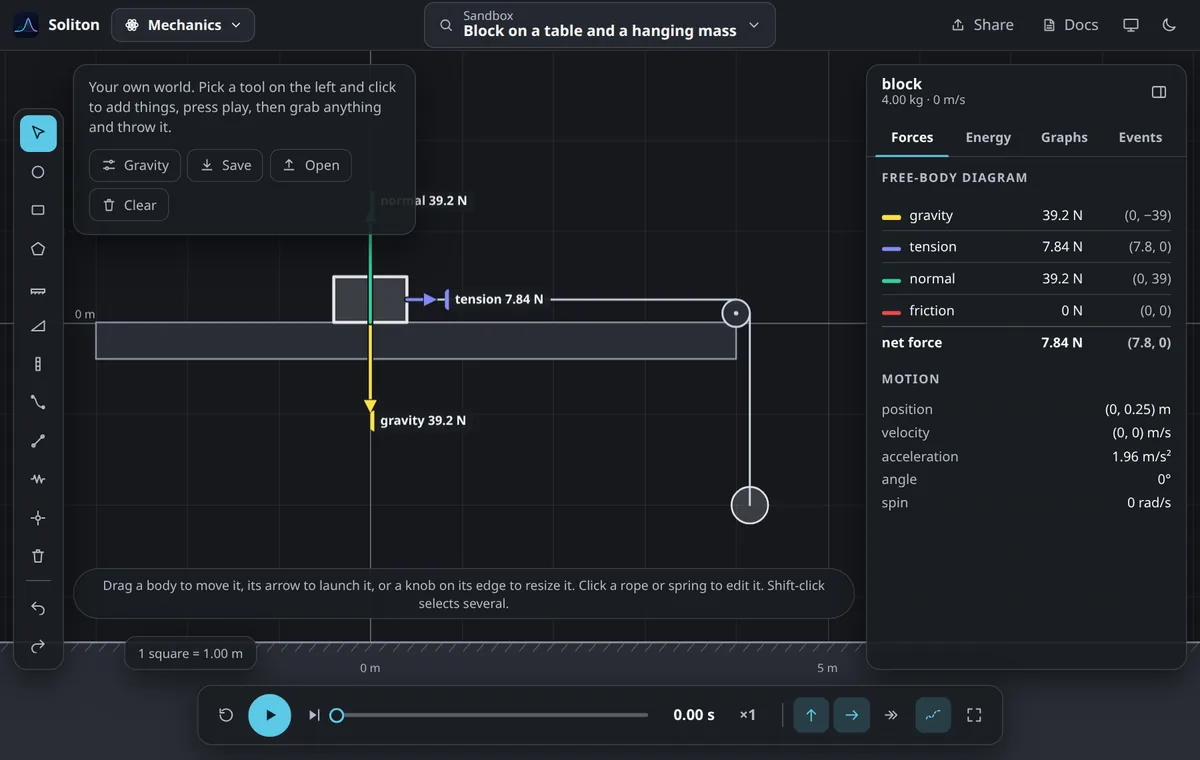
Press play. Every arrow is a force the engine actually applied, measured in newtons.
Build anything
Draw it, join it, let it go. If physics allows it, you can build it, and the engine will show you exactly what happens and why.
Balls, boxes and shapes of any outline. Platforms, inclines and walls. Join them with ropes over pulleys, rods, springs and pins, give them friction and bounce, then press play. Or start from a sun and planets, change G and throw a comet in.
 Open the sandbox →
Batteries, resistors, capacitors, inductors, diodes and AC sources. Wire them any way you like and watch the current flow, solved from Kirchhoff's laws.
Wire a circuit →Add sine waves and pulses of your own, send them either way, and watch them add up into beats, standing waves and more.
Mix waves →Type any function. See its graph, its derivative, the area under it and its integral, worked out step by step.
Plot a function →In the classroom
Every chapter of NCERT class 11 and 12, for boards, JEE and NEET, with the textbook's answer set beside the engine's.
What the formula predicts and what the engine measured, side by side. Students watch the formula come true.
Gravity, normal, friction, tension: the arrows are the forces actually applied. Pause at any instant and read them off.
Press T and everything grows bigger and bolder for the back row. Graphs, energy bars and an event log in every scene.
Every scene, with your numbers in it, is a link. Send it on WhatsApp and students open exactly what you showed.
The whole syllabus
Pick a chapter and the simulation opens straight away.
For developers
Build simulations into your app, your course or your notebook. Free to use, including commercially.
2,223 downloads
WebAssembly for the browser and Node. JavaScript API →
1,969 downloads
NumPy in and out, for notebooks and research. Python guide →
Questions
Yes. The playground, the sandbox and every simulation are free to use, for anyone: students, teachers, schools and the simply curious. Nothing to sign up for.
Yes. The sandbox lets you draw balls, boxes, any polygon, platforms, inclines and walls, join them with ropes, rods, springs and pins, or start from a sun and planets and throw in a comet. There is a circuit builder for batteries, resistors, capacitors, inductors and diodes, a wave lab for mixing waves, and a maths mode where you type any function. Everything you build can be shared as a link.
Every chapter of NCERT physics for class 11 and class 12, from motion in a straight line to semiconductor electronics. It serves CBSE and state boards, and the same physics JEE and NEET ask about.
No. It runs in any modern browser, on a laptop, a phone or a smartboard. Share a link and it opens exactly the scene you showed.
Yes. Press T for projector mode: text, arrows and lines grow bigger and bolder so the back row can read them.
Nothing is pre-recorded. A physics engine computes every force, path and graph as you watch, and the result is set beside the textbook's formula, so students can see the formula come true and change the numbers themselves.
Yes. Any simulation can be embedded, and the engine itself is on npm as @soliton-physics/engine and on PyPI as soliton-physics, free to use including commercially.
For teachers and institutes
Everything here is free to use in class today: 151 simulations across every NCERT chapter, a projector mode, and links that open exactly what you set up. We are also building classroom tools with a few teachers. If you would like a say in what comes next, write to us.